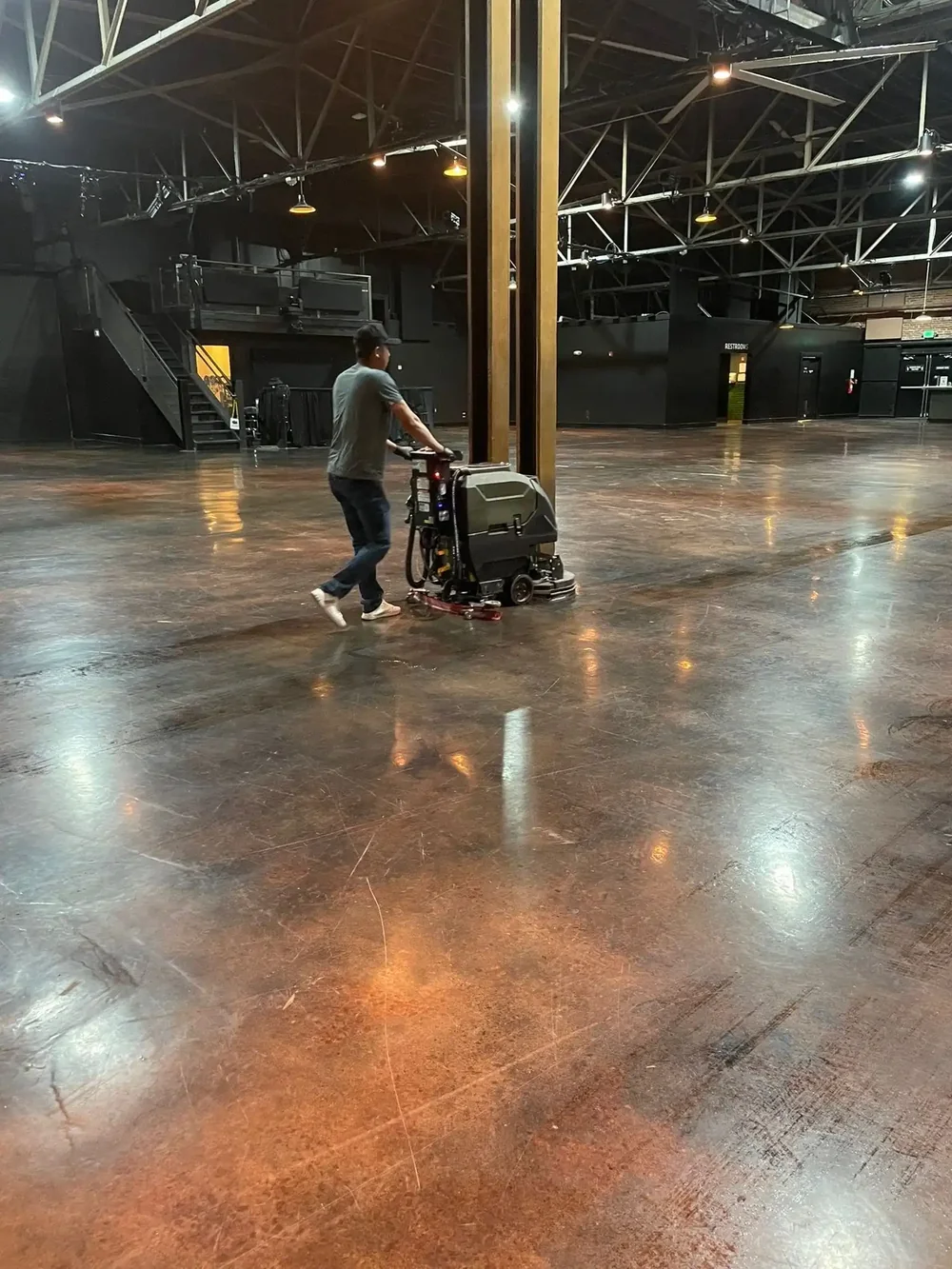
If you run a small business or manage a commercial property, the cleaning decision usually comes down to two clear choices: hire your own cleaner on payroll or contract a commercial cleaning service. Neither option is universally cheaper. The right financial answer depends on how many labor hours your building requires each week, how much internal management time you can spare, and what happens when your single on-staff cleaner calls in sick.
This guide breaks down the verified costs you can confirm through public labor benchmarks, the hidden overheads you must estimate for your own facility, and the exact operational situations where each option makes financial and management sense. As a professional cleaning company serving Middle Tennessee, we provide outsourced commercial cleaning services—so we have a commercial stake in this evaluation. In this guide, we explicitly show you where hiring in-house is the superior choice and where contracting out delivers clear advantages.
Key Takeaways for Nashville Facility Decision-Makers
- Wages are only the first cost layer: The national median janitor wage is $17.71 per hour, and mandatory federal employer payroll taxes (FICA) add at least 7.65% ($1.35/hr) directly on top, bringing base labor cost to $19.06 per hour before any benefits, insurance, supplies, or management time (BLS Occupational Outlook Handbook, May 2025; IRS Employer Tax Rules).
- Benefits represent 30.0% of total compensation: Across U.S. private industry, employer-provided benefits average $14.07 of $46.89 per hour worked (BLS Employer Costs for Employee Compensation, June 2026). If you offer benefits or PTO to an in-house employee, factor this substantial commitment in.
- Outsourcing consolidates all overheads into one billed invoice: A contracted commercial cleaning rate covers chemicals, industrial equipment, field supervision, workers’ compensation insurance, and built-in backup coverage for absences. National marketplace benchmarks quote recurring commercial office cleaning at $20 to $80 per cleaner hour or $0.10 to $0.20 per square foot (Housecall Pro, updated October 16, 2026).
- Control vs. Coverage trade-off: In-house hiring fits best when you need continuous daytime presence (day porter) and direct moment-to-moment control over tasks. Outsourcing fits best when facility cleaning requires part-time evening hours, zero employer liabilities, and guaranteed coverage when staff is absent.
What Does It Cost to Employ an In-House Cleaner?
To evaluate an in-house hire accurately, you must start with base market wages and add each compulsory employer burden. According to the U.S. Bureau of Labor Statistics, the national median wage for janitors and building cleaners is $17.71 per hour (BLS May 2025 OOH Data). Local market rates across Nashville and Davidson County vary based on commercial density and experience.
On top of gross pay, federal law requires employers to pay their mandatory share of FICA payroll taxes:
- Social Security Tax: 6.2%
- Medicare Tax: 1.45%
- Total Employer FICA: 7.65%
Applying 7.65% to a $17.71 hourly wage adds $1.35 per hour, yielding an immediate direct payroll subtotal of $19.06 per hour.
Median Cleaner Pay vs. Marketplace Billed Rates (USD Per Hour)
Comparing differing financial quantities: a base internal employee cost vs. a fully loaded commercial client billed rate.
$17.71 / hr
$19.06 / hr
$20.00 / hr
$80.00 / hr
Sources: BLS Occupational Outlook Handbook (May 2025); IRS Publication 15 Employer Tax Guide; Housecall Pro Commercial Pricing Benchmark (updated Oct 16, 2026). Note: Marketplace billed rates are client prices covering vendor profit, insurance, equipment, and administrative overhead—not employee wages.
Six Hidden Costs Missing From the Base Wage
The $19.06 per hour wage and FICA figure represents only the starting baseline. If you employ a cleaner directly, you must calculate and budget six additional expenditure categories:
- Employee Benefits & Paid Time Off (PTO): According to BLS Employer Costs for Employee Compensation (released September 9, 2026), benefits account for 30.0% of total compensation across private industry ($14.07 of $46.89 per hour worked). While this average spans all industries, offering vacation days, sick leave, or health contributions significantly increases your hourly commitment.
- Workers’ Compensation & State Unemployment Insurance (SUTA): Janitorial work involves wet floors, heavy lifting, and chemical handling. Premiums depend on your state classification code, company safety record, and insurer underwriting.
- Janitorial Supplies & Capital Equipment: In-house teams require you to purchase commercial vacuum cleaners, microfiber mops, safety buckets, PPE, EPA-registered sanitizing chemicals, trash liners, and restocking supplies. If your building features hard surfaces, an auto-scrubber or floor burnisher requires thousands in capital outlay.
- Management, Training & Quality Audits: Someone inside your organization must interview, onboard, train on safety protocols (such as OSHA bloodborne pathogens and SDS compliance), create task schedules, and conduct daily inspections.
- Absence Coverage & Business Disruption: When your sole in-house cleaner calls in sick, takes scheduled PTO, or experiences an emergency, who cleans the building? Either office managers or employees perform the janitorial tasks, or the facility remains dirty until their return.
- Recruiting, Turnover & Retraining: The BLS projects approximately 321,800 janitorial job openings per year nationally, primarily driven by workers leaving the occupation. Replacing a departed cleaner requires job ads, interviews, background checks, and lost productivity.
What Do You Get When You Outsource Commercial Cleaning?
When you contract a professional commercial cleaning company, you purchase a turnkey facility solution for a single predictable monthly invoice. The service vendor assumes full responsibility for hiring, training, equipment, chemical inventory, supervisory inspections, and substitute crew coverage when staff is absent.
According to Housecall Pro’s 2026 national pricing benchmark, recurring commercial office cleaning rates generally range between $0.10 and $0.20 per square foot, with hourly billing spanning $20 to $80 per cleaner hour (Housecall Pro, updated October 16, 2026).
- Aggregator figures reflect national averages: Middle Tennessee commercial square-footage rates reflect local commercial real estate dynamics, floor layouts, and Davidson County labor market supply.
- Clarify square-footage invoicing terms: National rate ranges rarely state whether the per-square-foot figure is billed per visit or per month. Always require bidders to specify the billing cadence explicitly in writing.
Remember that a vendor’s billed rate must cover direct labor, statutory taxes, general liability and workers’ compensation insurance, equipment depreciation, supplies, field supervision, and operating margin. The lowest bid in a market often strips out supervision or supply quality. Read our complete guide to commercial cleaning prices and scopes to learn how to evaluate bids.
How Do Control and Flexibility Compare?
The decision between an employee and a vendor contract involves fundamental operational trade-offs across eight core management factors:
| Evaluation Factor | In-House Cleaner (Employee) | Outsourced Commercial Cleaning Service |
|---|---|---|
| Day-to-Day Control | Direct: You assign tasks in real time and redirect priorities immediately as needs arise. | Structured: Changes are coordinated through a written scope of work and field supervisor. |
| Management Time | High: You recruit, onboard, train, schedule, conduct performance reviews, and audit. | Low: The cleaning vendor manages scheduling and crew supervision; you inspect results. |
| Absence Coverage | Your Responsibility: When they are sick or take leave, internal staff must cover or work pauses. | Vendor Guaranteed: Built into the service agreement; replacement cleaners are dispatched automatically. |
| Specialty Services | Limited: Requires purchasing expensive machines (extractors, buffers) or hiring external contractors. | Accessible: Carpet extraction, floor waxing, and window washing are readily scheduled through the same partner. |
| Scalability | Slow: Adding hours requires modifying employee contracts or initiating new hiring cycles. | Agile: Scaling visits or crew size up or down requires a single scope amendment. |
| Cost Visibility | Fragmented: Costs are dispersed across payroll, FICA, benefit plans, supply invoices, and equipment repairs. | Consolidated: A single, predictable monthly invoice covering all labor, supplies, and management. |
| Accountability | HR Management: Governed by standard employee performance management and disciplinary procedures. | Contractual SLA: Governed by written quality checklists, response windows, and contract termination terms. |
| Security & Access | Familiarity: You know the individual personal history and establish close daily rapport. | Procedural: Protected through pre-screened named crews, tracked access keys, and bonded $2M liability coverage. |
Key Operational Insight: Neither column wins every row. If you require a dedicated daytime presence who builds personal familiarity with your staff, an internal employee fits naturally. If you require reliable night cleaning without managing human resources, payroll liabilities, and equipment inventory, an outsourced contract is the superior operational model.
Where Can Outsourcing Go Wrong?
Outsourcing carries specific operational risks that must be understood and priced into your decision:
- Quality Variance Over Time: Janitorial turnover at low-cost vendors can lead to rotating crew members who drift from the original scope of work.
- Restrictive Contract Terms: Beware of long multi-year lock-ins, aggressive price escalation clauses, or 90-day cancellation hurdles. Professional vendors offer 30-day cancellation clauses for uncorrected quality deficiencies.
- Less Immediate Day-to-Day Task Direction: You cannot command contract cleaners to perform ad-hoc personal tasks outside the written agreement without submitting a scope change.
- Security and Credential Management: If a vendor rotates staff without notice, building access security can become difficult to track. Require contractual guarantees for named, pre-screened crew members.
When Does Hiring In-House Make Sense?
Hiring an internal cleaning employee is typically the best operational strategy when:
- You need continuous daytime presence (Day Porter): Busy medical facilities, large schools, corporate headquarters, and high-turnover retail spaces benefit from having an on-site cleaner who continuously monitors restrooms, responds instantly to lobby spills, and restocks breakrooms during business hours.
- You have sufficient workload to justify a full-time role: The property requires 30 to 40 hours of cleaning and basic maintenance weekly, eliminating the inefficiency of paying for travel and vendor margins on small scopes.
- You require tight control over tasks and access: Facilities handling proprietary technology, sensitive client records, or high-security areas often prefer knowing their staff personally.
- Your organization has active management capacity: You possess the HR, payroll, and supervisory infrastructure to hire, train, inspect, and manage janitorial personnel effectively.
- You have a built-in plan for absence coverage: You employ cross-trained maintenance or facility staff who can seamlessly cover cleaning duties when the primary cleaner is on vacation or sick.
The Popular Hybrid Model: Many Nashville enterprises utilize an effective hybrid arrangement: an in-house employee handles daytime upkeep, trash runs, and spill response, while an outsourced commercial contractor performs nightly sanitization, high dusting, and periodic commercial floor waxing and scheduled janitorial maintenance.
When Does Outsourcing Make Sense?
Contracting a commercial cleaning partner is generally the most cost-effective and headache-free route when:
- Your cleaning requirements are part-time: If your office requires 2 to 4 hours of cleaning 3 nights a week (6 to 12 hours total), employing an in-house staff member creates disproportionate administrative overhead.
- You want zero payroll, tax, or workers’ comp management: You eliminate payroll withholding, unemployment filings, workers’ comp insurance audits, and equipment purchasing.
- You need recurring specialty capabilities: Outsourced vendors possess commercial hot-water extractors, floor burnishers, and pressure washers, executing deep restorative work without capital equipment investment.
- You demand guaranteed absence coverage: If an assigned cleaner is ill, the contractor automatically dispatches a trained backup cleaner, ensuring your facility is clean every morning.
- Your facility footprint or schedule changes frequently: Adjusting cleaning frequency, expanding to a new suite, or modifying service hours requires a simple email or scope amendment rather than hiring or laying off personnel.
If you choose to outsource, protect your investment by requiring a clear written scope, active COI naming your business, defined issue turnaround times, and strict key security. Our office cleaning checklist and onboarding guide shows how to set up an effective 30-day trial.
How Do You Compare the Two Options for Your Own Facility?
Rather than relying on abstract general rules, calculate the true comparison using your facility’s specific numbers:
- Audit required weekly cleaning hours: Calculate actual time required to clean restrooms, vacuum open workspaces, empty wastebaskets, and sanitize breakrooms.
- Price the in-house option fully: Add hourly base wage + 7.65% employer FICA taxes + estimated benefits/PTO + workers’ comp and unemployment insurance + monthly chemical/equipment purchases + internal supervisory hours.
- Obtain standardized written quotes from commercial contractors: Solicit bids based on the exact same written scope of work and confirm whether quotes include all supplies, equipment, and absence coverage.
- Add an explicit line item for sick and vacation coverage: For in-house, estimate the cost of hiring temporary staff or diverting internal managers. For contractors, confirm absence cover is included in the base fee.
- Budget periodic specialty maintenance separately: Identify annual carpet extraction, window washing, and floor waxing costs.
- Evaluate non-cost operational factors: Weigh management bandwidth, liability exposure, access security, and how quickly your organization needs to pivot.
A Simple Annual Cost Formula for In-House Cleaning
[Annual Labor Hours × (Hourly Wage × 1.0765)] + Benefits & PTO + Workers’ Comp & SUTA Insurance + Cleaning Chemicals & Equipment Costs + Internal Supervisory Labor Time + Absence Coverage Costs
Frequently Asked Questions About In-House vs. Outsourced Cleaning
Is it cheaper to hire a janitor on staff or hire a commercial cleaning company?
It depends entirely on your total required hours and what cost factors you include. The BLS national median janitor wage is $17.71 per hour before employer taxes, benefits, workers’ comp, cleaning equipment, and absence coverage. Contracted commercial cleaning typically averages $20 to $80 per cleaner hour or $0.10 to $0.20 per square foot, which includes all supplies, supervision, insurance, and backup coverage. For part-time needs under 25 hours per week, outsourcing is almost always less expensive once total overhead is calculated.
What employer payroll taxes do I pay on an in-house cleaner?
Employers are federally required to pay 6.2% for Social Security and 1.45% for Medicare, for a combined 7.65% FICA contribution on gross wages. Employers must also pay Federal Unemployment Tax (FUTA) and Tennessee State Unemployment Tax (SUTA), alongside state workers’ compensation insurance premiums.
Who covers cleaning duties when an in-house cleaner is sick or on vacation?
With an in-house employee, you are responsible for finding coverage. Either internal staff, office managers, or temporary agency workers must step in, or the office goes uncleaned. With a contracted commercial cleaning partner, backup coverage is legally guaranteed in the agreement; when an assigned cleaner is absent, the contractor dispatches an alternate crew member at no extra cost.
Can a business use both an in-house employee and a commercial cleaning contractor?
Yes. A hybrid arrangement is widely used across Nashville corporate and healthcare facilities. An internal employee or day porter handles daytime hospitality, continuous restroom maintenance, and emergency spill response, while an outside commercial cleaning service performs after-hours vacuuming, trash collection, deep disinfection, and periodic floor care.
What should I ask a commercial cleaning company before outsourcing?
Before signing an outsourced contract, request: (1) a Certificate of Insurance with at least $1,000,000 to $2,000,000 in general liability naming your company as an additional insured, (2) verification of employee background checks and training programs, (3) confirmation of how absences are covered, (4) an explicit list of task exclusions, and (5) a defined turnaround window for resolving quality complaints.
Compare Your In-House Costs Against a Transparent Nashville Quote
If you manage a business in Nashville or Middle Tennessee and want an objective number to place beside your in-house labor budget, TNT Commercial Services 615 will walk your facility and deliver an itemized, transparent scope of work.
Locally owned and headquartered at 4900 Centennial Blvd, Nashville, TN 37209. Serving Davidson, Williamson, Rutherford, and Sumner counties with fully bonded, insured commercial cleaning solutions.
About This Cost & Control Guide
This operational guide was developed by Tavarus Taylor and the facility solutions team at TNT Commercial Services 615 utilizing verified federal labor data from the U.S. Bureau of Labor Statistics (BLS Occupational Outlook Handbook and Employer Costs for Employee Compensation), the Internal Revenue Service (IRS), and national commercial industry pricing benchmarks from Housecall Pro. National labor medians and mathematical formulas represent planning estimates and do not replace personalized tax, legal, or accounting advice.
Related Commercial Cleaning Guides
- Office Cleaning Checklist & 30-Day Onboarding Plan
- Corporate Office Cleaning in Nashville: Scope, Cost & Security
- Commercial Cleaning Services Prices & Budgeting
- Professional Business Cleaning Services in Nashville: A Guide by Building Type
- Commercial Cleaning Services in Nashville: 2026 Facility Guide & Costs
- Best Commercial Cleaning Company in Nashville: Evaluation Checklist
- Commercial Floor Waxing & VCT Refinishing Service
- Janitorial Services for Commercial Buildings in Middle Tennessee
- Explore All TNT Commercial Services 615 Solutions
- Schedule an On-Site Walkthrough