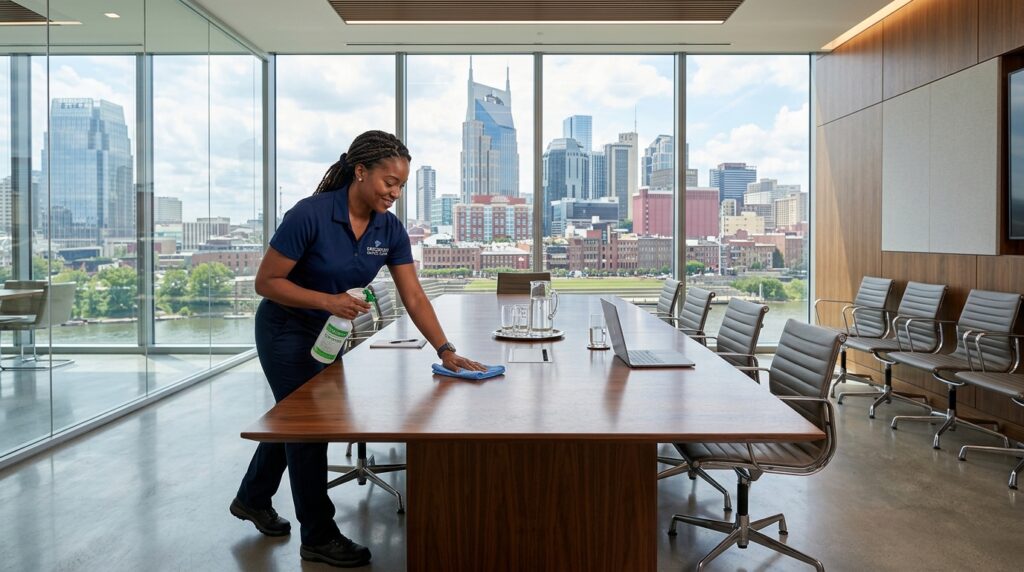
Corporate office cleaning works when four things are written down before the first visit: the scope of work, the frequency for each area, the price basis, and the security rules for the people entering your building after hours. If any of the four is vague, you have nothing concrete to inspect the vendor against.
This guide is for office and facility managers in Nashville who are writing a request for quotes, replacing a vendor, or auditing the one they have. It doesn’t repeat the general “how to choose a cleaning company” advice. For that, see our office cleaning buyer’s guide and our overview of corporate interior cleaning.
Key Takeaways
- Write the scope as a task list by area, not as “general cleaning.” A task list is the only thing you can inspect against.
- Match frequency to how a space is used. Restrooms and breakrooms need the most frequent attention; private offices usually need the least.
- Published benchmarks put standard recurring office cleaning at $0.10 to $0.20 per square foot, but always confirm what period that price covers (Housecall Pro, updated October 16, 2026).
- Cleaning crews often work after hours with keys or access codes. Treat access control, background screening, and document handling as core contractual terms.
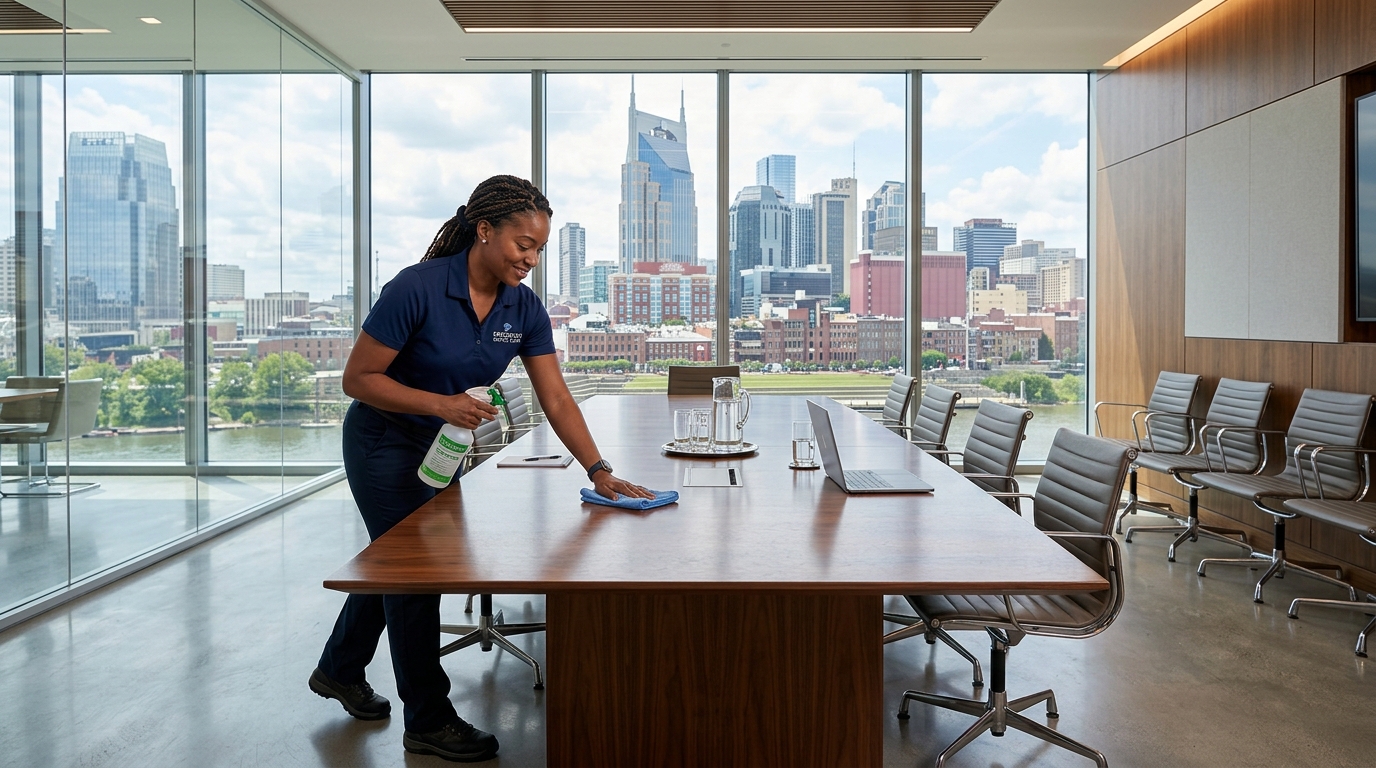
What Should a Corporate Office Cleaning Scope of Work Include?
A good scope of work lists every area, the tasks in it, and how often each task happens. “Clean the office” can’t be audited. “Empty and re-line all trash bins nightly” can.
Build the document in four layers:
- Area list: Reception, open workspace, private offices, conference rooms, restrooms, breakroom or kitchen, copy and print rooms, stairwells, elevators, and entry glass.
- Task list per area: Dust, vacuum, damp-mop, wipe, sanitize, empty, and restock.
- Frequency per task: Nightly, weekly, monthly, quarterly, or annual.
- Exclusions: State clearly what is not included, such as inside-of-fridge cleaning, server rooms, or personal desk contents.
Here is a starting template you can adapt for your Nashville facility:
| Area | Typical Recurring Tasks | Common Frequency |
|---|---|---|
| Reception and lobby | Glass, counters, floors, entry mats | Nightly |
| Open workspace | Trash, vacuum, spot-clean surfaces | 4 visits a week, nightly if busy |
| Private offices | Trash, vacuum, dusting | 2 visits a week |
| Conference rooms | Tables, chairs, trash, floors, AV wiping | 3 visits a week, or after heavy use |
| Restrooms | Fixtures, floors, restock soap & paper, trash | Nightly (5 visits a week), more in high-traffic buildings |
| Breakroom & Kitchen | Counters, sinks, microwave exterior, floors | Nightly |
| Hard floors | Machine scrub, buff, or refinish | Monthly to annually, by traffic |
| Carpet | Deep hot-water extraction | Quarterly to annually, by traffic |
| Interior windows & glass | Streak-free clean, fingerprints, partition glass | Monthly or quarterly |
These frequencies are common practice, not a rigid standard. Use them as a first draft and adjust to your company’s foot traffic, headcount, and specific floor types.
How Often Should a Corporate Office Be Cleaned?
Frequency should follow actual use, not habit. Cleaning a rarely used corner nightly spends budget where it adds little, while cleaning a busy restroom only three times a week leaves it dirty between visits.
A simple way to set your schedule is to rank each area by traffic and user density:
- High touch and high use (restrooms, breakrooms, entry doors): We recommend daily at minimum. Guidance from the CDC on cleaning and disinfecting facilities emphasizes that high-touch surfaces should be cleaned regularly and that busy communal areas call for more frequent cleaning or added disinfection.
- Moderate use (open workspace, conference rooms): Three to four visits per week.
- Low use (private offices, storage, rarely booked rooms): One or two visits per week.
- Periodic specialty work (carpet extraction, floor refinishing, window cleaning): Scheduled by season and traffic, not by the calendar.
Suggested Cleaning Visits Per Week by Area
Starting point for a typical corporate office, adjust to your traffic
5 visits / week
5 visits / week
5 visits / week
4 visits / week
3 visits / week
2 visits / week
Source: TNT Commercial Services 615 editorial planning guide (illustrative benchmark).
One common point of confusion is cleaning versus disinfecting. The CDC separates the two: cleaning with soap or detergent removes most germs, disinfecting kills what remains, and you should clean before you disinfect. It recommends disinfecting where people have obviously been ill. It does not call for routine chemical disinfection of every surface, so ask any vendor to explain why they would add it.
If your office uses hot desking or has substantial client traffic during the day, consider a dedicated day porter for restroom checks and rapid spill response, then keep heavy deep cleaning for the evening shift.
What Does Corporate Office Cleaning Cost in Nashville?
Published national benchmarks for standard recurring office cleaning cluster around $0.10 to $0.20 per square foot, with hourly rates quoted between $20 and $80 per hour according to 2026 marketplace data compiled by Housecall Pro from Thumbtack, Angi, and HomeGuide surveys.
Treat those as broad indicators rather than exact Nashville quotes. They come from marketplace estimates, and most online ranges fail to specify whether the per-square-foot figure is per individual visit or per monthly billing period. That ambiguity is exactly why you should require every bidding contractor to state their billing basis explicitly in writing.
Labor is the primary cost lever. The U.S. Bureau of Labor Statistics reports a median hourly wage of $17.71 for janitors and building cleaners. That is a national baseline, not a Nashville quote—use it to sanity-check bids that appear unrealistically cheap to support legal wages, workers’ compensation insurance, payroll taxes, and commercial-grade supplies.
Cleaner Pay vs. Typical Billed Hourly Rate (USD Per Hour)
Billed commercial contractor rates must cover overhead, taxes, supervision, and insurance beyond raw wages:
Sources: BLS Occupational Outlook Handbook; Housecall Pro commercial cleaning price guide 2026.
What Moves Your Price Up or Down
- Square footage and layout: A floor plan divided into dozens of small executive offices takes significantly more labor hours than an open bullpen of the identical square footage.
- Visit frequency: Five nights a week carries a higher monthly cost than three; ask each vendor how the per-visit rate scales with frequency.
- Restroom and breakroom count: High fixture counts require detailed hand scrubbing and replenishment, adding labor time.
- Floor compositions: Carpet, luxury vinyl tile (LVT), VCT, ceramic tile, and polished concrete each require unique chemicals and mechanical equipment.
- After-hours vs. day-porter coverage: Dedicated daytime staff requires distinct shift scheduling.
- Consumables procurement: Clarify whether commercial paper products, soap, trash can liners, and sanitizer dispensers are billed separately or bundled into the monthly agreement.
To compare bids fairly, supply every vendor with the identical task list and frequency matrix, then request the same four numbers: price per visit, price per month, hours on site per visit, and crew size. If one bid is drastically lower, verify whether it assumes a reduced scope or fewer on-site labor hours. For a deeper analysis, review our comprehensive commercial cleaning prices guide.
How Do You Keep an Office Secure When Cleaners Work After Hours?
Cleaning technicians typically enter corporate properties after business hours when your staff is gone. Building security must be treated as a binding contractual term, not an afterthought. Incorporate these seven protocols into your service agreement:
- Named Crew Roster: Require a written roster of technicians assigned to your facility and an advance notification protocol when team members change.
- Key & Access Control: Explicitly record who holds physical master keys, electronic RFID fobs, or alarm security codes, with mandatory same-day reporting of any lost credentials.
- Background Screening: Require verified multi-jurisdictional criminal background checks on all personnel entering your premises. Insist on written confirmation rather than verbal assurances.
- Restricted Access Zones: Clearly identify off-limits rooms (e.g., server IT closets, human resources file vaults, executive boardrooms) that require advance escort or remain locked.
- Clean-Desk Policy: Instruct employees to store confidential client files away and log off workstations at the end of each business day to protect data privacy.
- Comprehensive Insurance: Demand a formal Certificate of Insurance (COI) naming your business as additional insured with at least $2,000,000 in general liability and complete workers’ compensation.
- Incident & Discrepancy Reporting: Establish a documented protocol for reporting facility damage, unlocked doors, running water fixtures, or suspicious findings within two hours.
On health and safety compliance, OSHA standard 29 CFR 1910.1030 (Bloodborne Pathogens) mandates that commercial employers evaluate tasks involving potential biohazard exposure. Ensure your contractor trains employees on bloodborne pathogen protocols and biohazard spill response.
How Do You Measure Whether Corporate Cleaning Is Actually Good?
Inspect against your written scope on an agreed schedule with the exact same checklist every time. Without an objective checklist, quality control degenerates into conflicting subjective opinions.
Implement this proven oversight routine:
- Bi-Weekly Walkthroughs: Conduct weekly walkthroughs during month one, transitioning to every two weeks thereafter. Prioritize restrooms, kitchen areas, and executive entrances where foot traffic concentrates.
- Centralized Issue Log: Maintain a shared digital log or direct management communication channel where facility staff can log missed items for prompt resolution.
- Periodic Quality Audits: Verify hard-surface floor shine, carpet freshness without musty odors, and streak-free partition glass under directional lighting.
- Guaranteed Response Times: Require written corrective service commitments—such as resolving non-urgent items by the next scheduled visit and responding to urgent facility issues within two hours.
- Quarterly Scope Reviews: Schedule quarterly reviews to calibrate scope and frequencies as your company’s headcount and department layouts evolve.
If repeated discrepancies occur, document them against the signed task checklist before escalating. A dated checklist gives your provider specific operational data to correct. For warning signs to watch out for, read the red flags section in our commercial office cleaning services near me guide.
Should You Bring in Specialty Services Alongside Daily Cleaning?
Certain heavy facility maintenance tasks do not belong in a routine nightly scope. Bundling them into separate periodic work orders ensures transparent pricing and independent quality inspection:
- Floor Stripping and Waxing: Recommended every 6 to 12 months for VCT and resilient surfaces. Our commercial floor waxing guide details maintenance cycles and cost factors.
- Commercial Window Washing: Semi-annual interior and exterior architectural glass care. Review our commercial window washing service guide.
- Post-Construction Cleanup: Required following tenant improvements or office remodeling. See our detailed post-construction cleaning guide.
- Carpet Extraction: Hot-water extraction scheduled quarterly or semi-annually to eliminate deep allergen build-up.
- Exterior Power Washing: Sidewalk degreasing and facade cleaning. Explore our TNT power wash services.
Contracting these specialty capabilities with your primary janitorial partner simplifies vendor management while maintaining single-source accountability across your entire property.
Frequently Asked Questions About Corporate Office Cleaning in Nashville
What is included in corporate office cleaning?
A standard corporate office cleaning scope includes trash and recycling removal, vacuuming carpets, dry and damp mopping hard floors, dusting surfaces, sanitizing restrooms, restocking paper and soap products, and cleaning breakroom appliances. Periodic restorative work—such as carpet steam extraction and vinyl floor refinishing—is typically scheduled separately.
How often should a corporate office be cleaned?
Cleaning frequency depends on daily headcount and traffic density. High-traffic zones like restrooms, kitchens, and reception lobbies require daily cleaning (5 nights per week). Open workspaces and conference rooms typically need 3 to 4 visits weekly, while low-traffic private offices often require 1 to 2 visits weekly.
How much does corporate office cleaning cost in Nashville?
Corporate office cleaning in the Nashville area generally averages between $0.10 and $0.20 per square foot, or hourly rates from $20 to $80 per hour depending on facility specifications, layout complexity, and cleaning frequency. Comprehensive facility quotes are established through an on-site walkthrough.
Is it safe to let a cleaning crew in after hours?
Yes, provided your vendor enforces strict security protocols. Ensure your provider utilizes dedicated, background-checked W-2 employees (not unvetted sub-contractors), tracks keycard access, enforces a clean-desk policy, and carries at least $2,000,000 in commercial general liability insurance.
Do I need a day porter for my Nashville office?
Offices with high visitor traffic, frequent client conferences, hot-desking, or over 50 on-site employees benefit significantly from a day porter. A day porter monitors restroom cleanliness, restocks consumables, and manages continuous daytime spills, allowing the evening crew to focus on deep sanitization.
About TNT Commercial Services 615
This guide was authored by Tavarus Taylor and the facility management team at TNT Commercial Services 615. Founded in 2022 and locally owned in Nashville, Tennessee, TNT Commercial Services 615 has completed over 1,000 commercial projects across Davidson, Williamson, and surrounding Middle Tennessee counties. We deliver owner-operated accountability, $2,000,000 in commercial insurance, and tailored janitorial scopes for corporate, medical, and industrial facilities.
Ready to Put a Scope in Writing for Your Nashville Office?
If you manage a corporate office in Downtown Nashville, Brentwood, Cool Springs, Franklin, or the greater Middle Tennessee region, TNT Commercial Services 615 will walk your facility and provide an itemized task list and transparent proposal.
Request Your Customized Corporate Office Cleaning Proposal
Get dependable, owner-operated corporate office cleaning built around your building’s exact schedule and security requirements.