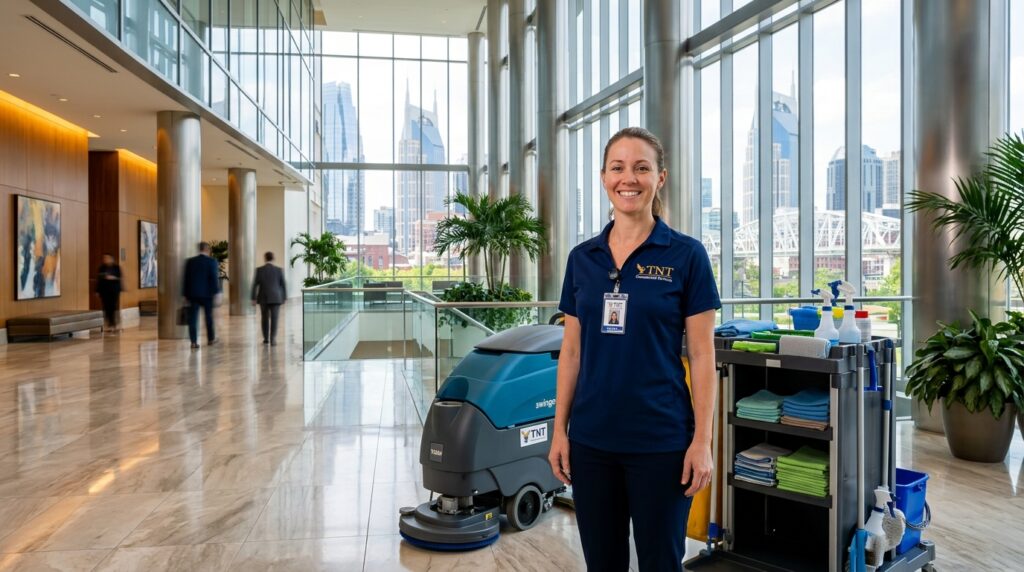
Professional business cleaning means a trained, insured, supervised crew working from a written scope that fits your building. An office, a clinic, a restaurant, and a warehouse all need different things, so the useful question is not “who cleans businesses?” but “what does my kind of building need, and how do I check that I’m getting it?”
This guide is for Nashville business owners and facility managers. It covers what a professional service should include, how cleaning requirements differ by commercial facility type, what moves the price in Middle Tennessee, and how to rigorously vet a provider. Each section links to a deeper guide if you need specific operational details.
Key Takeaways for Nashville Facility Managers
- “Professional” is verifiable: A written scope of work, active proof of insurance naming your business, trained and supervised crews, and a transparent system to report and resolve missed work.
- Needs differ by building type: Restrooms and high-touch surfaces matter everywhere, but food service, healthcare, retail, and construction add specialized regulatory compliance and equipment.
- 2026 Pricing Benchmarks: Published industry data benchmarks standard recurring office cleaning at $0.10 to $0.20 per square foot, with hourly rates typically between $20 and $80. Specialty, one-time, or after-hours work prices higher (Housecall Pro, updated October 16, 2026).
- Apples-to-apples bidding: Always require every bidder to quote the exact same written scope of work. Without standardized specifications, prices cannot be meaningfully compared.
What Makes a Business Cleaning Service “Professional”?
A truly professional commercial cleaning service can demonstrate five core operational standards before setting foot on your property for the first visit. If a vendor cannot provide these five items, treat that gap as essential decision-making information:
- A written scope of work: Explicit documentation detailing exact areas, tasks, and visit frequencies—not generic promises of “general cleaning.” See our corporate office cleaning guide to see how to structure one.
- Proof of insurance: Require a Certificate of Insurance (COI) that specifically names your company as an additional insured, and verify coverage limits against your commercial lease or corporate risk policy.
- Trained and supervised crews: Inquire directly: Who trains the cleaning staff, who inspects completed work on-site, and on what scheduled frequency?
- A defined method for quality control: A verifiable digital or written checklist, scheduled managerial walk-throughs, and a contractual response window for correcting missed tasks.
- Clear access and security protocols: Pre-screened, named crew members, strict tracking of keys and electronic keycards, and defined protocols for restricted rooms and after-hours alarm arming.
A Note on Credentials: Industry memberships or certifications (such as ISSA or OSHA certifications) are worth asking about, but only count the ones you can independently verify with the issuing organization. A claim with no way to check it is marketing, not operational evidence.
How Do Cleaning Needs Differ by Building Type?
The core janitorial baseline is universal: trash removal, floor maintenance, restroom sanitization, and high-touch surface disinfection. The divergence stems from who occupies the space, foot traffic volume, and regulatory mandates set by law or commercial insurers.
The table below provides an editorial planning baseline for primary building types. Traffic volume and unique facility operations should always refine your actual schedule:
| Building Type | What Changes | Typical Rhythm | Common Add-ons | Deeper Guide |
|---|---|---|---|---|
| Office Facilities | Mostly after-hours service, focus on restrooms, breakrooms, and shared touchpoints | Several visits a week (2–5×) | Carpet hot-water extraction, interior glass, day porter | Corporate office cleaning |
| Medical & Dental | Patient-facing surfaces, stricter infection-control expectations, cross-contamination prevention | Daily, often with day coverage | EPA List N disinfection protocols, clinical waste segregation | Medical cleaning checklist |
| Restaurant & Food Service | Grease mitigation, food-contact sanitization, health inspection readiness | Daily, plus scheduled deep cleans | Kitchen hood/exhaust cleaning, commercial floor degreasing | Restaurant cleaning |
| Retail & Showrooms | Customer-facing presentation, high-traffic floor shine, glass entrance clarity | Daily, timed around opening hours | Floor stripping, waxing, buffing, storefront window cleaning | Commercial floor cleaning |
| Industrial & Warehouse | Large square footage, airborne dust, heavy debris, safety-driven floor routines | A few visits a week, plus floor cycles | Industrial ride-on scrubbing, exterior concrete pressure washing | Industrial cleaning |
| New Construction & Renovation | Phased one-time cleanup, fine particulate dust, paint/caulk residue removal | One-time in phases (Rough, Final, Fluff) | HEPA air filtration, frame cleaning, sticker removal, floor finish | Post-construction cleaning |
1. Commercial Offices
Offices represent the most common commercial environment. Service is conducted predominantly after normal business hours. The quality issues noticed earliest by employees and tenants are restroom cleanliness, breakroom sanitation, and front entry presentation.
The CDC recommends that high-touch surfaces (doorknobs, handrails, light switches, elevator buttons) be cleaned regularly with soap or detergent before applying disinfectants, emphasizing that high-traffic areas warrant more frequent sanitization cycles (CDC Facility Cleaning Guidelines).
2. Medical and Dental Offices
Medical environments significantly elevate infection control requirements. Facility managers must verify how vendor crews handle biohazard spills and whether they receive formal bloodborne pathogen training.
Under OSHA’s Bloodborne Pathogens Standard (29 CFR 1910.1030), employers must document which tasks carry occupational exposure risks. Your facility exposure control plan must explicitly demarcate what an outside janitorial crew is authorized to clean versus clinical tasks reserved for staff. Clinical sharps and biohazardous waste must remain in internal care unless serviced by a certified biomedical waste contractor.
3. Restaurants and Food Service
Hospitality and dining establishments require complete kitchen floor degreasing, immaculate guest restrooms, and food prep areas maintained to pass local health inspections. Food service sanitation mandates are regulated at the state level; facility operators should verify compliance directly with the Tennessee Department of Health.
Kitchen exhaust hood cleaning is separate, specialized mechanical work governed by NFPA 96 standards. Inspection intervals depend on cooking volume and fuel type (e.g., solid fuel versus standard gas ranges). Consult your local fire marshal and commercial insurer to ensure your contractor works to the enforced municipal code. Explore our restaurant cleaning protocols and commercial pressure washing services.
4. Retail, Showrooms, and Industrial Warehouses
These properties center primarily on floor performance. Large polished concrete or VCT warehouse floors require auto-scrubbers, while customer-facing boutiques and retail showrooms require high-durability floor finishes that resist scuffs under sustained foot traffic.
Exterior entry plazas, sidewalks, loading docks, and dumpster pads are best managed through routine hot-water pressure washing, which should be budgeted as a dedicated line item. See our commercial floor care services and industrial cleaning capabilities.
5. Construction and Renovation
Post-construction cleaning is a multi-phased project comprising a rough clean, a final clean, and a pre-handover touch-up detail pass. Work must be carefully scheduled with the general contractor to manage airborne particulate dust.
Because masonry, drywall, and concrete cutting release hazardous respirable crystalline silica, contractors must observe federal safety standards. OSHA outlines strict dust-control and HEPA filtration mandates on its silica guidance portal. Review our complete Nashville post-construction cleaning guide.
What Does Professional Business Cleaning Cost in Nashville?
According to Housecall Pro’s 2026 pricing benchmark, standard recurring commercial office cleaning across the United States typically averages $0.10 to $0.20 per square foot, with hourly labor rates ranging between $20 and $80 per cleaner hour. That data compiles rates from national service aggregators including Thumbtack, Angi, and HomeGuide, noting that one-time deep cleanings, biohazard sanitation, and after-hours emergency dispatches price at the higher end of the spectrum (Housecall Pro, updated October 16, 2026).
- These figures represent nationwide aggregator medians, not site-specific Nashville quotes. Middle Tennessee commercial real estate dynamics, local labor rates, and building layout heavily influence actual estimates.
- Aggregator benchmarks rarely clarify whether square-footage pricing is calculated per visit or per month. Ensure every vendor explicitly states their invoicing basis in writing before signing.
Commercial cleaning pricing in Nashville is determined by five primary operational variables:
- Square Footage and Layout: High fixture counts (multiple private restrooms, executive kitchenettes, multi-stall washrooms) require significantly more labor hours than open floorplate warehouses.
- Frequency of Service: Increasing frequency from 2× per week to 5× per week reduces per-visit rates because soil accumulation between visits is lower.
- Building Type & Compliance: Medical facilities and commercial kitchens require specialized EPA-registered chemicals, higher PPE standards, and certified supervisor sign-offs.
- Floor Composition: Carpeted suites requiring semi-annual hot-water extraction or VCT tiles requiring annual strip-and-wax service are quoted as specialized periodic treatments.
- Service Timing: Day porter schedules versus overnight or weekend window dispatches carry different wage differentials.
For a line-by-line financial breakdown, consult our detailed commercial cleaning pricing guide.
How Do You Vet a Business Cleaning Company in Nashville?
To ensure an unbiased evaluation, apply the exact same seven-point vetting checklist to every commercial bidder:
- Standardize the scope: Provide every bidder with the exact same written scope of work and require them to detail price per visit, monthly flat fee, estimated on-site man-hours, and assigned crew size.
- Request an active Certificate of Insurance (COI): Verify that the policy lists your business as an additional insured with at least $1,000,000 to $2,000,000 in commercial general liability coverage plus full workers’ compensation.
- Evaluate training and supervision: Confirm who conducts employee onboarding, whether supervisors inspect completed jobs on-site, and how often written quality audits occur.
- Demand local commercial references: Ask for at least two current references managing facilities of similar square footage and building type in the Nashville market, and call them directly.
- Walk the property together: Never accept a quote generated strictly over the phone or via internet estimation tools. A vendor who bids without walking the facility is guessing.
- Examine contract term and termination clauses: Avoid multi-year lock-ins with punitive exits. A professional agreement should allow 30-day cancellation for uncorrected service deficiencies.
- Establish issue resolution response windows: Contractually define how missed items are reported (via direct portal, email, or telephone) and establish a guaranteed turnaround window for resolution.
Middle Tennessee Service Proximity Matters
Vendor response time is directly tied to geographical density. A commercial cleaning contractor already servicing buildings near your property can dispatch backup crews, handle daytime emergency spills, and manage supply restocking far faster than an operator traveling from across the state.
TNT Commercial Services 615 provides commercial cleaning services throughout Davidson County and surrounding Middle Tennessee communities, including:
- • Downtown Nashville & The Gulch
- • MetroCenter & West End
- • Brentwood Commercial Corridors
- • Franklin Corporate Centers
- • Murfreesboro Commercial Districts (View guide)
- • Hendersonville & Sumner County
Frequently Asked Questions About Business Cleaning in Nashville
What do professional business cleaning services include?
A standard recurring scope covers trash and recycling removal, HEPA-filtered vacuuming, hard floor dust mopping and damp mopping, surface dusting, sanitization of touchpoints, complete restroom disinfection and consumable restocking, and breakroom sanitization. Periodic treatments such as carpet extraction, machine floor scrubbing, window washing, and pressure washing are typically scheduled and invoiced separately.
How much do commercial business cleaning services cost in Nashville?
National 2026 benchmarks estimate standard recurring office cleaning at $0.10 to $0.20 per square foot, with hourly rates spanning $20 to $80 per cleaner hour (Housecall Pro, updated October 2026). Actual Nashville quotes vary based on facility layout, visit frequency, and flooring materials. Request a customized walk-through for fixed pricing.
How often should a business facility be cleaned?
Cleaning frequency depends entirely on traffic and building type. Most corporate offices clean restrooms, breakrooms, and lobbies daily (or 3–5 times per week) and private executive offices 2 times per week. Medical offices and restaurants require daily or multi-shift service. The CDC recommends regular cleaning of high-touch surfaces, with accelerated frequencies for high-traffic environments.
Should our commercial cleaning contractor be insured and bonded?
Yes, without exception. Request a Certificate of Insurance (COI) that names your enterprise as an additional insured. Verify that general liability limits (typically $1M to $2M) and workers’ compensation meet or exceed your commercial lease requirements and corporate risk guidelines.
Do I need separate vendors for specialty cleaning services?
Not necessarily. Full-service commercial contractors like TNT Commercial Services 615 provide both recurring janitorial maintenance and specialty solutions (such as hard-surface floor refinishing, hot-water carpet extraction, and pressure washing). However, specialty projects should always be quoted as distinct line items with measurable deliverables.
Get a Written Commercial Cleaning Quote for Your Nashville Building
If you manage a business, medical clinic, office suite, or commercial facility in Nashville or Middle Tennessee, TNT Commercial Services 615 will conduct a comprehensive on-site walk-through and deliver a transparent, customized scope of work.
As a locally owned Nashville cleaning company headquartered at 4900 Centennial Blvd, we have a stake in your satisfaction. Compare our transparent written scope with any vendor in Middle Tennessee.
About This Guide
This commercial facility guide was prepared by Tavarus Taylor and the TNT Commercial Services 615 operational team utilizing verified public health, labor, and safety data from the CDC, OSHA, Tennessee Department of Health, and Housecall Pro. Cost benchmarks reflect national industry medians and planning baselines; official pricing requires an on-site facility walkthrough.
Related Commercial Cleaning Guides
- Corporate Office Cleaning in Nashville: 2026 Guide & Costs
- Commercial Cleaning Services in Nashville: 2026 Facility Guide & Costs
- Best Commercial Cleaning Company in Nashville: Evaluation Checklist
- Post-Construction Cleaning Services in Nashville
- Commercial Cleaning Services Prices & Budgeting
- Commercial Office Cleaning Services Near Me
- Explore TNT Commercial Services 615 Solutions
- Schedule a Free Facility Walkthrough