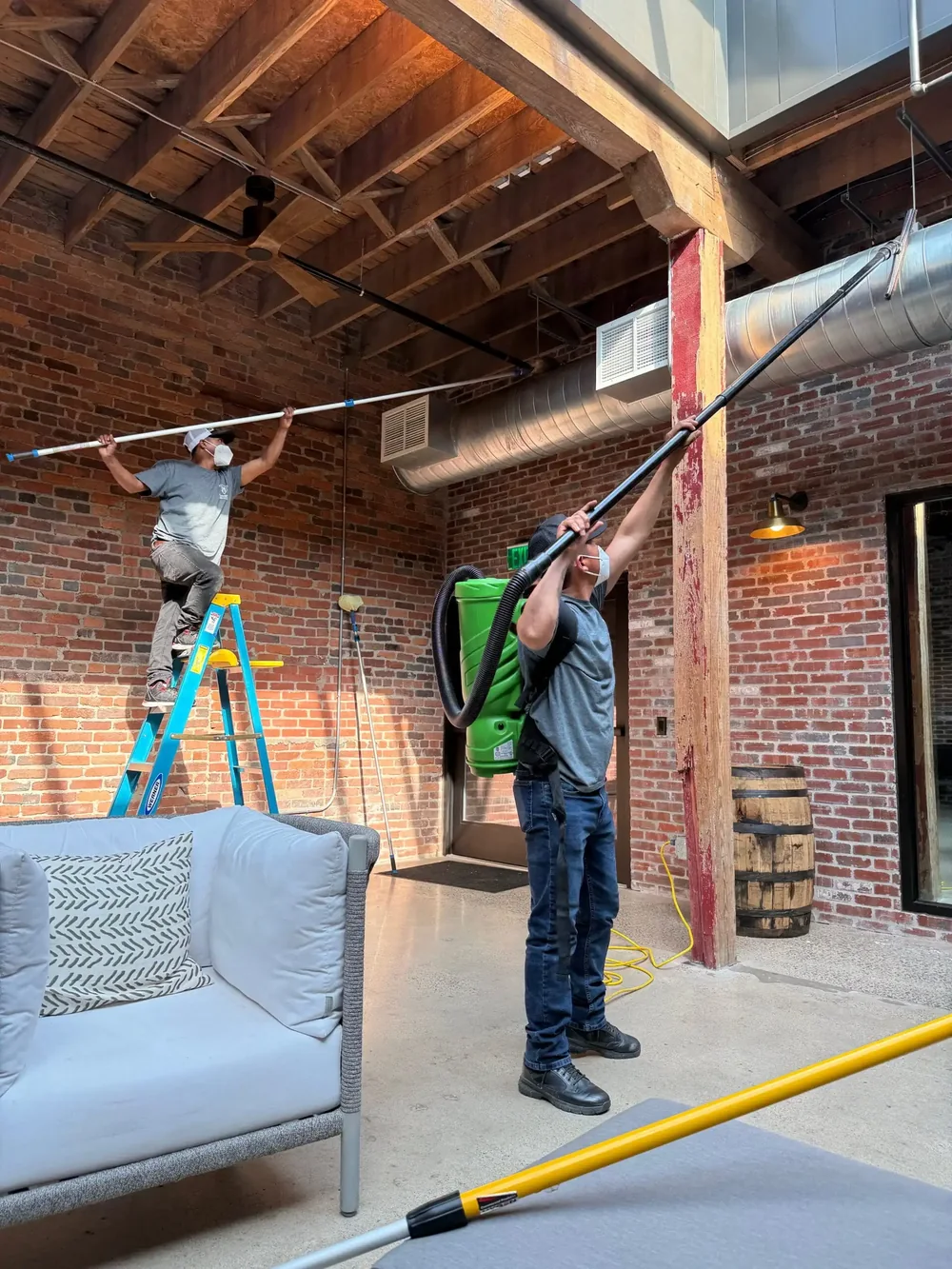
- Core Priorities: Warehouse cleaning is mostly about floors, dust, and safe access. Large floor areas are maintained with specialized commercial machinery on a schedule tailored around your operational workflow.
- OSHA Walking-Working Surfaces: OSHA’s rule requires employers to keep workplaces clean, orderly, and sanitary, with floors kept clean and as dry as feasible, and surfaces free of hazards such as spills (29 CFR 1910.22). While a professional cleaning contractor supports these standards, legal compliance duty remains with the facility operator.
- Hazard Communication: Cleaning chemicals require proper container labels, up-to-date Safety Data Sheets (SDS), and documented worker training under OSHA’s Hazard Communication Standard (29 CFR 1910.1200).
- Vetting Essentials: Request an on-site walkthrough, a written scope separating routine from periodic work, proof of comprehensive liability insurance ($2M+), and documented protocols for working safely around forklifts and wet surfaces.
Warehouse cleaning services Nashville TN keep large, busy buildings safe to work in: floors free of spills and debris, dust under control, dock areas and break rooms kept in order, and a plan that fits around forklifts and shift schedules. A warehouse is not a big office, so the scope, the equipment, and the safety questions are different.
This guide is for warehouse managers, distribution center operators, and facility managers in the Nashville area who are hiring a cleaning provider or evaluating their current vendor. It explains what the work includes, how floor scrubbing and dust control fit in, what OSHA rules require for housekeeping and chemicals, and how to thoroughly vet a commercial contractor. (“OSHA compliance” here refers to the housekeeping and chemical-safety fundamentals supported by a professional cleaning program, not a guarantee that any vendor can independently certify your site compliant. As a commercial cleaning contractor serving Middle Tennessee, we provide these services, so we encourage facility managers to compare our scope and standards against any bidder.)
What Do Warehouse Cleaning Services Include?
The exact scope depends on your building, but most warehouse and distribution center programs combine routine daily/weekly tasks with scheduled periodic deep cleaning. The table below outlines a standard starting framework based on established commercial practice:
| Facility Area | Typical Recurring Tasks | Periodic Deep Tasks |
|---|---|---|
| Warehouse Floor & Aisles | Sweeping, debris and pallet-scrap pickup, spot cleaning of oil/fluid spills | Ride-on and walk-behind machine scrubbing of concrete slabs |
| Loading Docks & Receiving | Sweeping, trash removal, wiping overhead door guides and dock plate surfaces | Commercial pressure washing of exterior dock aprons and concrete staging pads |
| Offices & Break Rooms | Trash emptying, vacuuming, surface sanitization, break room table wiping | Commercial carpet hot-water extraction and hard-surface floor refinishing |
| Restrooms & Locker Areas | Fixture disinfection, partition sanitization, damp mopping, supply restocking | Machine scrub decontamination of ceramic tile and deep grout restoration |
| High Areas & Racking | Not usually recurring during standard daily shifts | High dusting of ceiling rafters, overhead steel trusses, conduit, ledges, and racking tops |
| Exterior & Parking Lots | Litter sweep, compactor area debris cleanup, cigarette receptacle servicing | High-pressure power washing of dumpster corrals and parking bay degreasing |
Two key practices ensure a warehouse scope remains clear and enforceable:
- Document Exclusions: Explicitly note areas outside the scope, such as active high-density racking aisles during operational shifts, cold-storage/refrigerated vaults, or restricted-access electrical sub-stations.
- Separate Routine from Periodic Line Items: Keep daily/weekly sweeping and trash removal distinct from periodic machine scrubbing or high dusting so each service is priced, inspected, and validated independently.
For a broader look at comprehensive facility programs, review our overview of industrial and commercial cleaning across Middle Tennessee.
How Does Industrial Floor Scrubbing Work?
Across large distribution footprints, traditional mops and buckets are ineffective and slow. Automatic floor scrubbers apply a tailored chemical solution, mechanically agitate the surface with heavy-downpressure cylindrical brushes or abrasive pads, and vacuum the resulting slurry into a recovery tank in a single continuous pass. This rapid recovery leaves concrete clean, dry, and immediately accessible.
The appropriate scrubber, pad density, and cleaning agent depend on your specific slab surface:
- Bare / Unsealed Concrete: Highly porous and prone to absorbing hydraulic oil; requires alkaline industrial degreasers and nylon-grit brushes.
- Sealed & Polished Concrete: Requires pH-neutral commercial cleaners to protect the lithium silicate densifier and maintain high-gloss reflectivity.
- Epoxy Coatings: Durable yet sensitive to aggressive solvent attacks; requires non-abrasive poly pads to remove forklift rubber without dulling the protective coating.
- Administrative VCT & Vinyl: Located in dispatch offices; benefits from regular high-speed burnishing and periodic protective finish recoating.
Safety Protocols for Wet Floor Operations
Under OSHA standards, floors must be kept clean and, to the extent feasible, dry (29 CFR 1910.22(a)). When evaluating cleaning providers, ask these four operational questions:
- When do you scrub? Scheduling scrubbing between shift changes or over weekend downtime isolates wet floors from forklift traffic and pedestrian pickers.
- How are wet zones marked and dried? Look for high-visibility physical barriers, warning cones, and parabolic squeegees that verify complete moisture recovery before reopening an aisle.
- How do you navigate tight racking aisles? While ride-on scrubbers excel in main thoroughfares, narrow picking aisles and pallet staging corners often require compact walk-behind units.
- How do you handle hydraulic and petroleum spills? Oil spills demand specialized oil-binding absorbent and emulsifying degreasers, not standard mop water that spreads grease films.
For deeper insights on floor treatments, consult our Middle Tennessee commercial floor care guide.
How Do You Control Dust in a Warehouse?
Industrial dust settles on overhead ledges, structural racking, bar-code scanners, and crated product, ultimately migrating down onto concrete thoroughfares. A reliable warehouse dust mitigation plan addresses three core pillars:
- Scheduled High-Bay Dusting: Ceiling rafters, structural I-beams, lighting transoms, and overhead HVAC ductwork accumulate fine fibrous dust from cardboard packaging. Professional contractors deploy HEPA-filtered industrial backpack vacuums and carbon-fiber extension poles to capture overhead particulate without releasing dust showers onto floor inventory.
- Dust-Controlled Floor Sweeping: Dry push-broom sweeping suspends micro-particulate back into facility breathing zones. Commercial auto-scrubbers and enclosed vacuum sweepers utilize pre-dampening mist systems and high-efficiency filtration to capture dust at floor level.
- Source Control & Exterior Mitigation: A significant portion of warehouse dust originates outdoors or from packaging breakdown. Implementing walk-off entrance matting at pedestrian portals and scheduling exterior dock apron washing dramatically lowers incoming grit.
Important Safety Notice: Combustible Dust & Height Safety
If your facility processes chemicals, agricultural grains, plastics, or fine wood fibers, accumulated dust may represent a combustible hazard governed by NFPA and OSHA guidelines. Combustible dust assessments are specialized technical evaluations that must be directed by your Environmental Health and Safety (EHS) officer or insurance carrier, not an outside janitorial vendor.
Furthermore, confirm height safety protocols before overhead work begins. Operators utilizing boom lifts or scissor lifts must carry documented OSHA Fall Protection training and deploy proper personal fall arrest systems (PFAS).
What Do OSHA Rules Say About Warehouse Housekeeping & Chemicals?
While OSHA does not issue a single bundled “warehouse cleaning standard,” several enforceable General Industry regulations establish mandatory housekeeping and chemical safety obligations:
1. Walking-Working Surfaces (29 CFR 1910.22)
Employers must ensure that all places of employment, passageways, storerooms, service rooms, and walking-working surfaces are maintained in a clean, orderly, and sanitary condition. Floors must be kept clean and dry to the extent feasible, with continuous drainage provided wherever wet processes occur (29 CFR 1910.22).
2. Hazard Communication Standard (29 CFR 1910.1200)
Whenever cleaning personnel bring industrial degreasers or chemical sanitizers onto your property, OSHA’s HazCom standard mandates compliant GHS labeling, accessible Safety Data Sheets (SDS), and documented chemical safety training for on-site staff (29 CFR 1910.1200).
3. Powered Industrial Trucks (29 CFR 1910.178)
Forklift operating regulations require that fire aisles and emergency access corridors remain unobstructed (paragraph (m)(14)), and that fuel, battery acid, or oil leaks be promptly eliminated before equipment is placed back into operation (paragraph (p)(3)) (29 CFR 1910.178). Cleaning schedules and forklift traffic must be rigorously coordinated.
Key Takeaway: Contracting a professional cleaning company does not transfer an employer’s statutory legal liability. However, partnering with an experienced, safety-certified provider gives you a documented, auditable cleaning program that actively supports your workplace compliance.
How Do You Schedule Cleaning Around Warehouse Operations?
Operating logistics facilities run tight fulfillment schedules with peak shipping windows. Effective commercial contractors design sanitation plans that integrate smoothly into your operation:
- Off-Shift & Weekend Windows: Execute heavy machine auto-scrubbing, loading dock pressure washing, and overhead high dusting during 3rd shift lull periods or weekend shutdowns.
- Sector Phasing (Zoned Cleaning): Partition large 50,000+ sq. ft. facilities into distinct zones (e.g., Inbound Dock, Bulk Storage, Picking Aisles), cleaning one sector while other zones remain fully active.
- Traffic Coordination: Establish clear right-of-way rules between ride-on scrubbers and order pickers, designating who places physical safety cones and who authorizes aisle reopening.
- Surge Capacity for Peak Seasons: Ensure your vendor can scale crew sizes and shift hours ahead of fourth-quarter retail surges or seasonal inventory rotations.
- Secure Access Management: Logistics centers house valuable client inventory. Verify that cleaning crews use uniform badging, background checks, and documented keycard or lock-box access protocols, as outlined in our commercial cleaning contract guide.
What Does Warehouse Cleaning Cost in Nashville?
Unlike commercial office janitorial services where standardized pricing models are widespread, industrial warehouse pricing varies significantly based on slab square footage, storage density, and specialized machinery requirements. Facility managers should evaluate bids based on specific operational variables:
- Floor Area & Surface Condition: Open staging concrete requires less labor per square foot than dense, narrow-aisle racking systems requiring compact scrubbers.
- Cleaning Frequency & Shift Timing: Daily multi-shift coverage generates a lower rate per visit than sporadic monthly deep cleaning, though off-shift or holiday work may involve shift differentials.
- Specialty Scope Items: High-bay rafter dusting, dock degreasing, and compactor pressure washing are customarily quoted as periodic add-ons.
- Obstacles & Floor Clutter: Pallet overhangs, staging congestion, and oil accumulation influence machine speed and detergent concentration.
When soliciting competitive proposals, require all vendors to quote against identical metrics: price per visit, monthly flat fee, estimated hours on site, and dedicated crew size. For additional price comparisons across commercial sectors, review our Nashville commercial cleaning pricing guide.
How Do You Vet a Warehouse Cleaning Company?
Use this 8-step vetting checklist before awarding an industrial cleaning agreement in Middle Tennessee:
- Conduct an On-Site Walkthrough: Any contractor who provides an industrial quote without inspecting your floor condition, slab joints, and dock layout is guessing.
- Demand a Written Scope of Work: Ensure recurring duties and periodic deep-cleaning intervals are explicitly documented alongside clear operational exclusions.
- Verify $2M+ Liability Insurance: Obtain a current Certificate of Insurance (COI) naming your business as an additional insured. Standard $1M residential policies are inadequate for industrial settings.
- Inspect Safety & HazCom Credentials: Review their documented OSHA Hazard Communication training, SDS binders, and personal protective equipment (PPE) standards.
- Audit Commercial Equipment: Confirm the contractor owns and maintains dedicated industrial ride-on scrubbers and HEPA extraction systems rather than relying on rental availability.
- Contact Industrial References: Request contact details for at least two current warehouse, logistics, or manufacturing clients in Middle Tennessee.
- Establish Quality Assurance Metrics: Define recurring digital inspection procedures, discrepancy reporting channels, and guaranteed correction response times.
- Review Agreement Terms: Carefully check cancellation clauses, 30-day notice requirements, and escalation terms before signing.
To understand what differentiates an experienced commercial contractor from an entry-level cleaning crew, read our guide to professional commercial cleaning.
Where Does TNT Commercial Services 615 Work?
TNT Commercial Services 615 is an owner-operated commercial and industrial cleaning contractor headquartered in Nashville, TN. Our service footprint encompasses Davidson County and the wider Middle Tennessee industrial corridor, including Brentwood, Franklin, Hendersonville, Smyrna, Lebanon, Mount Juliet, and Murfreesboro.
Explore our full commercial services list or view our regional coverage guide for Murfreesboro and Rutherford County. Before scheduling a project, our leadership conducts a thorough on-site evaluation to ensure our machinery and safety protocols align with your facility scope.
Frequently Asked Questions
What is usually in a warehouse cleaning scope?
A typical warehouse cleaning scope encompasses concrete sweeping and pallet debris removal, machine auto-scrubbing of main traffic aisles, loading dock and receiving area cleaning, restroom and breakroom sanitation, dispatch office janitorial care, and periodic specialty tasks such as high-bay rafter dusting and exterior dock pressure washing. Always confirm the exact frequency and task distribution in writing.
How often should warehouse floors be machine scrubbed?
Frequency depends on forklift traffic volume, pallet transit, and the nature of your inventory. High-traffic shipping corridors and dock staging aprons in multi-shift facilities generally benefit from daily or alternate-day auto-scrubbing. Secondary racking aisles are typically maintained on a weekly or bi-weekly schedule. A reputable contractor will recommend an optimized schedule following an on-site walkthrough.
Can a cleaning company make my warehouse OSHA compliant?
No cleaning vendor can unilaterally make a facility “OSHA compliant,” as statutory employer obligations under OSHA’s Walking-Working Surfaces standard (29 CFR 1910.22) remain with the facility operator. However, an experienced commercial cleaning contractor maintains clean, dry surfaces, manages fluid spills, and documents chemical safety under HazCom standards (29 CFR 1910.1200), providing the crucial operational foundation required for regulatory compliance.
What should I ask a warehouse cleaning company about chemicals?
Ask how all chemical containers are labeled under GHS standards, where on-site Safety Data Sheets (SDS) are housed, and how crew members are trained on spill containment and dilution protocols. OSHA’s Hazard Communication Standard mandates that all hazardous cleaning formulations brought onto your premises be clearly documented and properly handled.
What does warehouse cleaning cost in Middle Tennessee?
Because warehouse layouts vary from open logistics pads to high-density racking centers, reliable standard rates do not exist. Costs are driven by total square footage, required machine hours, visit frequency, obstacle density, and specialized equipment like scissor lifts. Request quotes based on uniform metrics: price per visit, monthly flat fee, on-site hours, and crew size.
About this guide
This guide was prepared by the TNT Commercial Services 615 technical team from public regulatory sources and commercial cleaning field experience. Regulatory citations are referenced from statutory texts published by Cornell Law School’s Legal Information Institute (29 CFR 1910.22, 29 CFR 1910.1200, and 29 CFR 1910.178). Operational scheduling, vetting criteria, and scope advice represent professional commercial recommendations. Facility operators must verify specific occupational regulations applicable to their building with their safety officer or legal counsel.