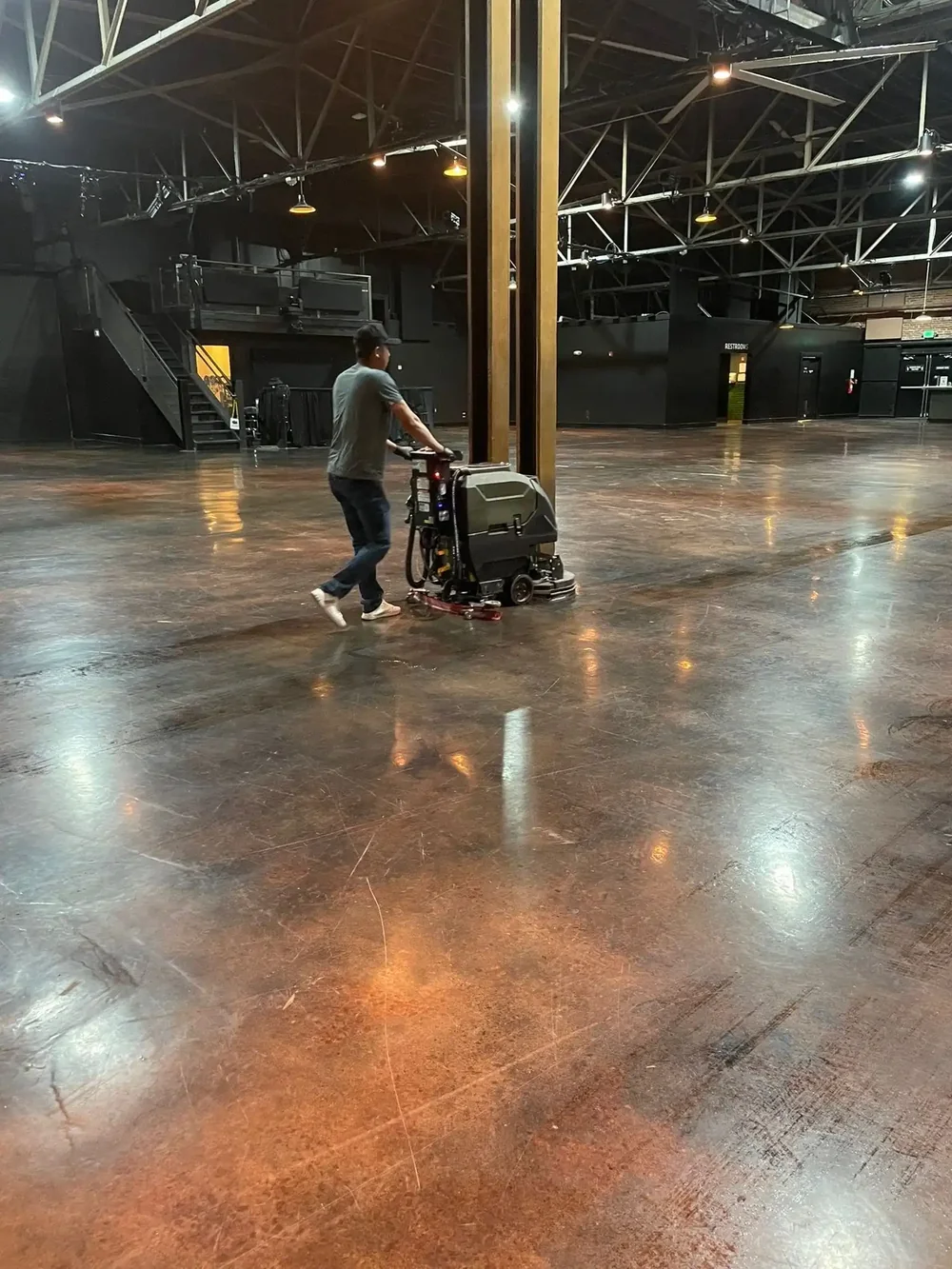
Professional commercial cleaning is cleaning done to a written scope, in a defined order, with the right products used the right way by people who have been trained to do it safely. That is what separates it from a quick wipe-down, and it is what you are paying for when you hire a service.
This guide explains what professional commercial cleaning involves, step by step, so you can judge whether your building is getting it. It is written for business owners and facility managers who are comparing providers or checking the one they have.
Key Takeaways
- Professional commercial cleaning follows an order: remove soil first, then disinfect where needed. The CDC says to clean surfaces before disinfecting, because dirt can make disinfectants less effective (CDC, April 2024).
- Products have to be used as directed: That means reading the label, respecting the contact time, never mixing chemicals, and training workers on the hazards.
- Method matters as much as product: tools, cloths, and technique are chosen by surface and area.
- Quality control is part of the service: In our view, that means checklists, inspections, and a stated way to report and fix misses.
What Does Professional Commercial Cleaning Actually Include?
It includes the visible tasks, such as trash, floors, restrooms, and surfaces, and the work behind them: planning, training, product control, and inspection. A useful way to see the difference is to compare what you can see with what sits behind it.
| What You Can See | What Sits Behind It |
|---|---|
| Clean floors, empty bins, stocked restrooms | A written scope, task frequencies, and a route for the crew |
| Surfaces that look and smell clean | The right product, applied in the right order and left on for the right contact time |
| A crew that shows up on schedule | Training, supervisor oversight, and a plan for covering absences |
| Few complaints | Inspections, a way to report misses, and a stated response time |
If the part on the right is missing, the part on the left tends to drift. Our office cleaning buyer’s guide covers how to choose a provider, and our Nashville commercial cleaning overview shows the full suite of services we offer.
Cleaning, Sanitizing and Disinfecting: What’s the Difference?
A professional crew treats these as different steps and does them in order. The Centers for Disease Control and Prevention (CDC) guidance on cleaning community facilities says that cleaning alone removes most types of harmful germs, and that disinfecting can kill harmful germs that remain on surfaces after cleaning.
Three points from that guidance shape a professional routine:
- 1. Clean first. The CDC says to clean surfaces before sanitizing or disinfecting them, because impurities like dirt may make it harder for the chemicals to kill germs.
- 2. Focus on high-touch surfaces. It lists examples such as door handles, stair rails, elevator buttons, touchpads, restroom fixtures, and desks, and says to clean them regularly.
- 3. Disinfect with a purpose. It recommends disinfecting areas where people have obviously been ill, and adding disinfection in high-traffic areas on top of cleaning.
The practical test is simple. If a provider says it “disinfects everything,” ask which surfaces, how often, and which product. A named task on named surfaces is something you can check. A blanket claim is not. The CDC page also notes its guidance is not intended for healthcare settings, so a medical clinic requires specialized protocols. See our medical office cleaning guide for that case.
How Do Professionals Use Products Safely and Correctly?
They treat the label as a set of instructions, not a suggestion. The CDC guidance for disinfecting lists the habits that matter:
- 1. Read the label to confirm the product can be safely used on the specific surface you are treating.
- 2. Respect the contact time (dwell time). The disinfectant has to stay on the surface long enough to work, and the surface should stay visibly wet for the whole contact time listed in the directions and the Safety Data Sheet (SDS).
- 3. Dilute exactly as directed. If the product has to be diluted, follow the label, using room-temperature water unless directed otherwise.
- 4. Never mix chemicals. The CDC warns that mixing products can be hazardous and change their chemical properties (such as mixing bleach and ammonia).
- 5. Use a registered product for the job. The CDC refers to EPA-registered disinfecting products tested for the specific germ, if known.
Worker safety is part of the same picture. The CDC says employers should train workers before assigning cleaning and disinfecting tasks, including reading labels about chemical hazards, properly labeling secondary bottles, and making Safety Data Sheets readily accessible. It also points employers to OSHA’s Hazard Communication Standard, 29 CFR 1910.1200. When you interview a commercial cleaning provider, ask how they train crews on chemical hazards and where Safety Data Sheets are kept. A confident, specific answer is a reliable sign of quality.
Which Methods and Tools Do Professional Crews Use?
Method is chosen by surface and area, and the details vary by company. The points below are our recommendations based on proven trade practice:
- Separate tools by area: We recommend keeping restroom microfiber cloths and mops strictly apart from the ones used in offices or breakrooms, typically through color-coding (e.g., red for restrooms, blue for general surfaces), so soil and pathogens are never cross-contaminated.
- Match the tool to the floor: Carpet, vinyl (VCT), tile, and polished concrete call for different tools and pH-balanced chemistries. Large hard-floor areas require an auto-scrubber machine instead of a traditional mop and bucket. See our commercial floor cleaning guide.
- Work in a set order (top-to-bottom, back-to-front): In our view, it makes sense to dust high surfaces before floors, and to finish with floors on the way out, so settled dust is not tracked back onto clean areas.
- Keep equipment clean: Dirty cloths and saturated mop heads spread soil. Always confirm how equipment is washed, sanitized, and replaced between jobs.
- Schedule deep work separately: Tasks such as carpet extraction, VCT stripping and waxing, pressure washing, and elevated high dusting are periodic. Our deep cleaning guide explains what belongs on that schedule.
How Is Quality Controlled in Professional Commercial Cleaning?
Quality control is what turns a good intention into a repeatable result. In our view, a commercial cleaning agreement should include four core pillars:
- 1. A Written Checklist: Every area, task, and frequency is written down, ensuring the crew and the client work from the exact same expectations.
- 2. Active Supervision: Someone other than the cleaning crew checks the work on a routine schedule.
- 3. A Clear Problem-Reporting System: Facility staff know exactly where to report a miss, and every report is time-stamped and logged.
- 4. A Guaranteed Response Time: The provider commits to resolving a reported miss within a stated window (e.g., within 24 hours), with a faster response for urgent issues like spills.
Can You Tell If Your Building Is Getting Professional Service?
Yes. Walk the building with a short checklist. These inspections require no special equipment:
- Restrooms: Check chrome fixtures, mirror edges, tile corners, and the base of toilets and partitions for buildup or missed grime.
- High-Touch Points: Look at door handles, stair railings, elevator buttons, and shared conference surfaces for greasy residue or smudges.
- Edges and Corners: Missed baseboards, corners, and behind doors point to rushed vacuuming or mopping.
- Smell: A clean building smells neutral. A lingering sour or chemical odor often points to a dirty mop, missed floor drain, damp carpet, or unemptied trash.
- Records: Ask to see the on-site checklist log and the supervisor’s last inspection notes.
- People: Ask who supervises the crew and how they are trained on OSHA chemical safety standards.
If most of these look good and the provider answers questions confidently, you are getting professional service. If several are weak, raise them in writing with dates and ask for an action plan.
Frequently Asked Questions
What is professional commercial cleaning?
It is commercial cleaning executed to a written scope by trained, supervised crews who use products as directed and follow defined quality-control processes. It goes far beyond surface wiping to include planning, training, product safety, and structured inspection.
What’s the difference between cleaning and disinfecting?
Cleaning removes dirt, dust, and impurities from surfaces using soap or detergent and water. Disinfecting uses EPA-registered chemicals to kill germs on surfaces. The CDC emphasizes that cleaning must precede disinfecting because organic dirt can neutralize the disinfectant.
Why does disinfectant contact time matter?
A disinfectant chemical must remain wet on the surface for the full dwell time specified on its label (often 3 to 10 minutes) to achieve its rated germ kill. Wiping it off immediately renders it ineffective.
Should every surface in a facility be disinfected?
Not necessarily. The CDC recommends regular cleaning of general surfaces and targeted disinfection of high-touch surfaces, restrooms, and areas where an illness was reported. A professional provider specifies exact surfaces rather than making blanket claims.
How do I know my provider cleans to a professional standard?
Ask how they train crews on OSHA HazCom safety, how they prevent cross-contamination between restrooms and offices, who performs supervisor inspections, and what their guaranteed response time is for reported misses.
See How We Work
If you manage a commercial property in Nashville or Middle Tennessee, TNT Commercial Services 615 will conduct a comprehensive on-site walkthrough and provide a transparent quote tailored to your exact written scope.
About this guide: This guide was prepared by the TNT Commercial Services 615 team. Product safety and cleaning order principles reference CDC guidelines for community facilities and OSHA 29 CFR 1910.1200 Hazard Communication standards. Always check specific regulations and Safety Data Sheets that apply to your facility.